Seven of Wands Card Meaning
Wands
- Upright Keywords
- defensestanding your groundconvictionthe high ground
- Reversed Keywords
- overwhelmedexhausted defensepointless stubbornness
- Yes / No:
- Maybe
Seven of Wands: Yes or No?
Maybe
Maybe — it depends on whether you hold your position. The Seven of Wands grants the outcome to whoever does not back down, so persistence decides this more than merit does. Reversed it leans no, usually where the defence has already been given up.
Overview
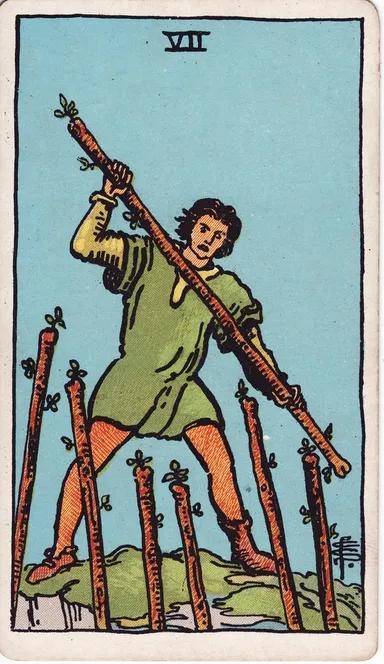
The Seven of Wands shows a man on a hilltop, staff braced across his body, facing six staves thrusting up from below. The challengers themselves are invisible — only their weapons rise into view, so he cannot even be sure who he is fighting. The telling detail in the Rider-Waite image is his feet: he wears one shoe and one boot, mismatched, as if he rushed out mid-dressing to meet the attack.
The moment the laurel is placed on your head in the Six of Wands, challengers appear who want the spot. The Seven is the card of defending what you have won. Crucially, the man still holds the hilltop — outnumbered, perhaps, but the terrain itself is on his side.
Upright Meaning
Upright, the Seven of Wands says this is a moment to hold, not fold. Pushback against your results, objections to your convictions, rivals eyeing your position — all of it is pressing uphill toward you. But you stand above them, carrying the advantage of the one who arrived first: experience, track record, and possession of the ground.
The card’s tactical advice is to shorten your front line. Answering every single attack only drains you. Decide which core positions genuinely must be held, and let the rest of the noise pass by — selective defense is how this battle is won. And perfection is not required to begin: the man in the mismatched shoes is holding the hill anyway.
Reversed Meaning
Reversed, the defense is reaching its limit. Demands and criticism arriving from every direction have worn you down, judgment is fogged by fatigue, and you may barely remember what you are holding the hill for. Under that pressure, some people surrender a position they could have kept simply because the strain became unbearable.
The opposite failure also lives here: gripping something that no longer deserves defending. A stance that lost its meaning long ago, an argument held only out of pride — that kind of defense is pure attrition. The reversed Seven asks one blunt question: is this a hill worth defending, or one you are free to walk down from? The answer sorts what to keep holding from what to set down.
In Love Readings
In love questions, the upright Seven of Wands describes a season of standing up for the relationship. Family disapproval, the appearance of a rival, rumors that shake the two of you — external pressure demands that you prove where you stand. A couple that passes through this test together usually comes out sturdier. In one-sided love, it reads as encouragement not to fold at the first sign of difficulty.
Reversed, check whether protecting the relationship has become a lonely, single-handed battle. A bond defended by only one person rarely lasts. Alternatively, you may be clinging to a connection that has already emptied out, held in place by pride or habit — a moment to ask honestly what, exactly, you are defending.
In Career & Money Readings
For work and career, the Seven of Wands marks a phase of defending your position and your results: objections raised against your project, latecomers closing the gap, scrutiny aimed at your track record. A composed, principled defense can itself become proof of your expertise. In interviews or negotiations, the deciding factor is staying unshaken under pressure questions.
With money, a defensive posture fits the moment — plug the leaks rather than chase new gains, and if a payment or right of yours is being disputed, assert it clearly. Reversed, ask whether the cost of defending something has grown larger than its worth, and redraw your criteria for when to hold and when to cut losses.
🔍 Reading the symbols
Tarot feels hard less because the keywords are hard to memorise than because it is unclear where in the picture they come from. This table draws the line between the two.
| In the picture | What it points to |
|---|---|
| Standing on high ground | The advantageous position is already yours. Defend well and you keep it. |
| Six wands from below | Multiple challengers, faces unseen — the opposition is real but ill-defined. |
| Mismatched shoes | Caught mid-preparation. You have to stand up before you feel ready. |
| A single staff | One weapon only. Don't defend everything; defend the one thing that matters. |
| Green cliff | The ground still holds. Your base survives the siege. |
🔗 When it appears with other cards
↗ Cards that sharpen it
- Strength Endurance turns quiet and durable — winning without raising your voice.
- Nine of Wands The defence runs to the final stretch. Exhausted, but nearly through.
↘ Cards that pull against it
- Ten of Wands Defending turns into carrying it all alone. You are holding what should be set down.
- The Hanged Man Stop fighting and change the angle. Holding the line may be the wrong answer.
A starting point, not a verdict. The real reading shifts with your question and the position.
💬 What actually happened
Tell us what really happened on a day this card came up. You can read what others recorded too.
Nothing here yet. Be the first to write one.